

의미론적 분할: 픽셀 단위 이미지 이해
시맨틱 세그멘테이션(Semantic Segmentation)의 원리를 FCN, U-Net, DeepLabV3+, SegFormer 관점에서 설명한다. 픽셀 단위 분류, 업샘플링, 스킵 연결, Atrous 합성곱, mIoU 지표를 코드와 함께 이해한다.
지난 글에서 이미지에서 물체의 위치를 경계 박스로 찾는 객체 탐지를 살펴봤다. 시맨틱 세그멘테이션(Semantic Segmentation)은 한 발 더 나아가 이미지의 모든 픽셀에 클래스 레이블을 할당한다. “이 픽셀은 도로, 저 픽셀은 사람, 이 픽셀은 하늘”처럼 픽셀 단위로 장면을 이해하는 것이다.
문제 정의
입력: (3, H, W) RGB 이미지
출력: (num_classes, H, W) 또는 (H, W) 각 픽셀의 클래스 인덱스
분류와 달리 출력이 이미지와 같은 크기여야 한다. 이를 밀집 예측(Dense Prediction)이라 한다.
FCN: 첫 End-to-End 시맨틱 세그멘테이션
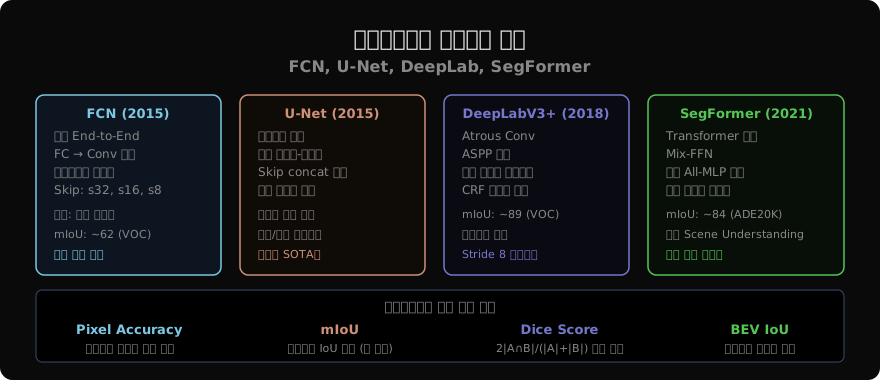
2015년 Long et al.이 제안한 FCN(Fully Convolutional Network)은 분류 네트워크의 FC 레이어를 합성곱으로 대체해 임의 크기 이미지에 적용 가능하게 만들었다.
import torch
import torch.nn as nn
import torch.nn.functional as F

class FCN32s(nn.Module):
    """VGG16 기반 FCN-32s"""
    def __init__(self, num_classes=21):
        super().__init__()
        import torchvision.models as models
        vgg = models.vgg16(pretrained=True)

        # VGG 특징 추출기 (풀링 5회 → 1/32 크기)
        self.features = vgg.features

        # FC를 Conv로 대체
        self.fc6 = nn.Conv2d(512, 4096, 7, padding=3)
        self.fc7 = nn.Conv2d(4096, 4096, 1)
        self.score = nn.Conv2d(4096, num_classes, 1)

    def forward(self, x):
        h, w = x.shape[2:]
        x = self.features(x)           # (B, 512, H/32, W/32)
        x = F.relu(self.fc6(x))
        x = F.relu(self.fc7(x))
        x = self.score(x)              # (B, C, H/32, W/32)
        # 원본 크기로 업샘플링
        x = F.interpolate(x, (h, w), mode='bilinear',
                          align_corners=False)
        return x                        # (B, C, H, W)
문제: 32× 업샘플링은 너무 거칠다. 경계가 흐릿하게 복원된다.
U-Net: 스킵 연결로 세밀한 경계 복원
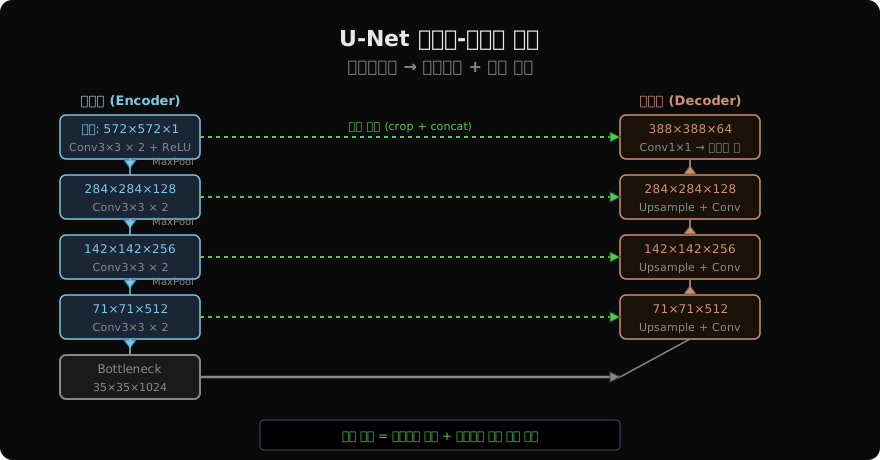
U-Net은 인코더에서 저장한 고해상도 특징을 디코더에 직접 전달(스킵 연결)한다. 인코더가 “무엇”을 담당하고, 스킵 연결이 “어디”에 있는지를 보존한다.
class DoubleConv(nn.Module):
    def __init__(self, in_ch, out_ch):
        super().__init__()
        self.net = nn.Sequential(
            nn.Conv2d(in_ch, out_ch, 3, padding=1, bias=False),
            nn.BatchNorm2d(out_ch), nn.ReLU(),
            nn.Conv2d(out_ch, out_ch, 3, padding=1, bias=False),
            nn.BatchNorm2d(out_ch), nn.ReLU()
        )

    def forward(self, x):
        return self.net(x)


class UNet(nn.Module):
    def __init__(self, in_ch=3, num_classes=2, base=64):
        super().__init__()
        # 인코더
        self.enc1 = DoubleConv(in_ch, base)
        self.enc2 = DoubleConv(base, base*2)
        self.enc3 = DoubleConv(base*2, base*4)
        self.enc4 = DoubleConv(base*4, base*8)
        self.pool = nn.MaxPool2d(2)
        # 병목
        self.bottleneck = DoubleConv(base*8, base*16)
        # 디코더
        self.up4 = nn.ConvTranspose2d(base*16, base*8, 2, 2)
        self.dec4 = DoubleConv(base*16, base*8)   # concat 후 2× 채널
        self.up3 = nn.ConvTranspose2d(base*8, base*4, 2, 2)
        self.dec3 = DoubleConv(base*8, base*4)
        self.up2 = nn.ConvTranspose2d(base*4, base*2, 2, 2)
        self.dec2 = DoubleConv(base*4, base*2)
        self.up1 = nn.ConvTranspose2d(base*2, base, 2, 2)
        self.dec1 = DoubleConv(base*2, base)
        # 출력
        self.out_conv = nn.Conv2d(base, num_classes, 1)

    def forward(self, x):
        # 인코딩
        e1 = self.enc1(x)
        e2 = self.enc2(self.pool(e1))
        e3 = self.enc3(self.pool(e2))
        e4 = self.enc4(self.pool(e3))
        b  = self.bottleneck(self.pool(e4))
        # 디코딩 (스킵 연결 concat)
        d4 = self.dec4(torch.cat([self.up4(b), e4], dim=1))
        d3 = self.dec3(torch.cat([self.up3(d4), e3], dim=1))
        d2 = self.dec2(torch.cat([self.up2(d3), e2], dim=1))
        d1 = self.dec1(torch.cat([self.up1(d2), e1], dim=1))
        return self.out_conv(d1)
DeepLab: Atrous 합성곱으로 수용야 확장
DeepLab 시리즈는 Atrous(구멍 있는) 합성곱으로 해상도를 줄이지 않고 수용야를 넓힌다.
# Atrous Convolution (rate=2이면 픽셀 간격 2칸)
atrous_conv = nn.Conv2d(256, 256, kernel_size=3,
                        padding=2, dilation=2)  # 수용야 5×5 효과

class ASPP(nn.Module):
    """Atrous Spatial Pyramid Pooling"""
    def __init__(self, in_ch, out_ch=256):
        super().__init__()
        self.conv1 = nn.Sequential(
            nn.Conv2d(in_ch, out_ch, 1, bias=False),
            nn.BatchNorm2d(out_ch), nn.ReLU()
        )
        # 다양한 rate로 다중 스케일 컨텍스트
        self.atrous6  = self._make_atrous(in_ch, out_ch, 6)
        self.atrous12 = self._make_atrous(in_ch, out_ch, 12)
        self.atrous18 = self._make_atrous(in_ch, out_ch, 18)
        # Global Average Pooling
        self.gap = nn.Sequential(
            nn.AdaptiveAvgPool2d(1),
            nn.Conv2d(in_ch, out_ch, 1, bias=False),
            nn.BatchNorm2d(out_ch), nn.ReLU()
        )
        self.proj = nn.Sequential(
            nn.Conv2d(out_ch * 5, out_ch, 1, bias=False),
            nn.BatchNorm2d(out_ch), nn.ReLU()
        )

    def _make_atrous(self, in_ch, out_ch, rate):
        return nn.Sequential(
            nn.Conv2d(in_ch, out_ch, 3, padding=rate,
                      dilation=rate, bias=False),
            nn.BatchNorm2d(out_ch), nn.ReLU()
        )

    def forward(self, x):
        h, w = x.shape[2:]
        gap = F.interpolate(self.gap(x), (h, w),
                            mode='bilinear', align_corners=False)
        out = torch.cat([self.conv1(x), self.atrous6(x),
                         self.atrous12(x), self.atrous18(x), gap], 1)
        return self.proj(out)
세그멘테이션 손실 함수
# 기본: CrossEntropy (픽셀당 분류 손실)
criterion = nn.CrossEntropyLoss(ignore_index=255)

# Dice Loss: 의료영상 클래스 불균형에 효과적
def dice_loss(pred, target, smooth=1.0):
    pred = pred.softmax(dim=1)
    num_classes = pred.shape[1]
    loss = 0
    for c in range(num_classes):
        p = pred[:, c]
        t = (target == c).float()
        intersection = (p * t).sum()
        loss += 1 - (2*intersection + smooth) / (p.sum() + t.sum() + smooth)
    return loss / num_classes

# 결합 손실 (CE + Dice)
def seg_loss(pred, target):
    return 0.5 * criterion(pred, target) + 0.5 * dice_loss(pred, target)
mIoU 계산
def compute_miou(preds, targets, num_classes):
    ious = []
    pred_flat = preds.flatten()
    tgt_flat  = targets.flatten()

    for c in range(num_classes):
        pred_c = (pred_flat == c)
        tgt_c  = (tgt_flat  == c)
        intersection = (pred_c & tgt_c).sum().item()
        union        = (pred_c | tgt_c).sum().item()
        if union > 0:
            ious.append(intersection / union)

    return sum(ious) / len(ious) if ious else 0.0
실전: torchvision 사전학습 세그멘테이션
import torchvision.models.segmentation as seg_models

# DeepLabV3+ with ResNet-101 backbone
model = seg_models.deeplabv3_resnet101(pretrained=True)
model.eval()

# 추론
with torch.no_grad():
    output = model(img_tensor)['out']  # (B, 21, H, W)
    pred = output.argmax(1)            # (B, H, W) 픽셀별 클래스

# 커스텀 클래스 수로 교체
model.classifier[4] = nn.Conv2d(256, num_classes, 1)
model.aux_classifier[4] = nn.Conv2d(256, num_classes, 1)
시맨틱 세그멘테이션은 자율주행(도로·차선·보행자 구분), 의료 영상(종양 경계 추출), 위성 영상 분석 등 픽셀 단위 이해가 필요한 곳이면 어디서나 핵심 기술이다. 다음 글에서는 세그멘테이션에서 한 단계 더 나아가 같은 클래스의 물체도 개별로 구분하는 인스턴스 세그멘테이션을 다룬다.
지난 글: 객체 탐지: 이미지에서 물체 찾기
다음 글: 인스턴스 분할: 물체를 개별로 구분하기
읽어주셔서 감사합니다. 😊