

itertools 기초: 조합형 이터레이터 완벽 활용
Python itertools 모듈의 핵심 함수를 정리합니다. count, cycle, repeat, chain, islice, takewhile, dropwhile, groupby, combinations, permutations, product, accumulate, starmap 등 이터레이터 조합 도구의 원리와 실전 활용 패턴을 다룹니다.
지난 글에서 time 모듈과 datetime 모듈의 차이를 살펴봤습니다. 이번 글에서는 이터레이터를 조합하고 변환하는 강력한 표준 라이브러리 itertools를 체계적으로 정리합니다. itertools는 메모리를 아끼면서 대용량 데이터를 처리하거나, 조합론 문제를 단 한 줄로 해결할 때 핵심 도구가 됩니다.
itertools란?
itertools는 이터레이터를 조합·변환·생성하는 함수들의 모음입니다. 모든 함수는 지연 평가(lazy evaluation) 방식으로 동작하여, 필요할 때만 값을 생성합니다. 이 덕분에 수십억 개의 조합을 생성해도 메모리를 거의 사용하지 않습니다.
import itertools
# 또는 자주 쓰는 것만 임포트
from itertools import chain, islice, combinations, groupby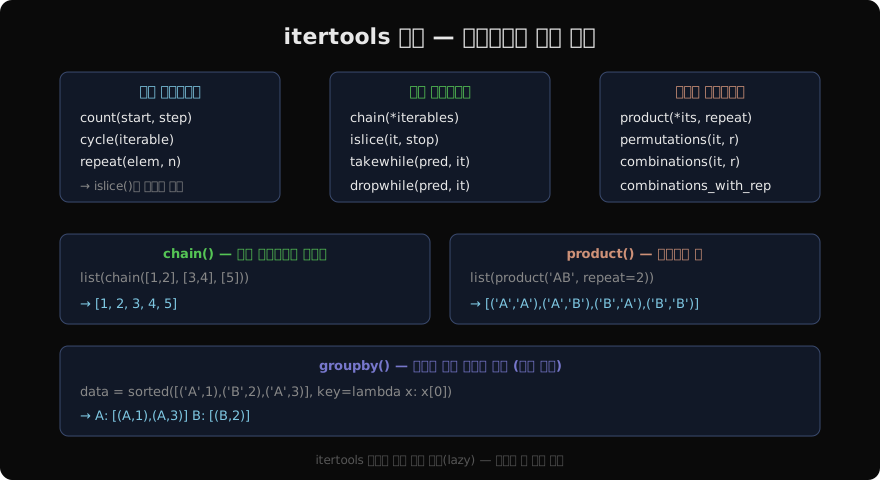
무한 이터레이터
무한 이터레이터는 끝없이 값을 생성합니다. islice()로 잘라 쓰는 것이 기본 패턴입니다.
from itertools import count, cycle, repeat, islice

# count(start, step) — 등차수열
list(islice(count(0, 2), 5))   # [0, 2, 4, 6, 8]

# cycle(iterable) — 순환 반복
colors = cycle(['빨', '초', '파'])
list(islice(colors, 7))        # ['빨', '초', '파', '빨', '초', '파', '빨']

# repeat(elem, n) — 같은 값 반복
list(repeat('X', 4)) # ['X', 'X', 'X', 'X']count()는 zip()과 조합하면 enumerate() 대체제로도 씁니다.
words = ['apple', 'banana', 'cherry']
list(zip(count(10), words))
# [(10, 'apple'), (11, 'banana'), (12, 'cherry')]
유한 이터레이터
chain — 여러 이터러블 연결
from itertools import chain

result = list(chain([1, 2], [3, 4], [5]))
# [1, 2, 3, 4, 5]

# 리스트의 리스트를 평탄화할 때
nested = [[1, 2], [3, 4], [5, 6]]
flat = list(chain.from_iterable(nested))
# [1, 2, 3, 4, 5, 6]chain.from_iterable()은 중첩 리스트를 1단계 평탄화하는 빠른 방법입니다.
islice — 슬라이싱
from itertools import islice

# islice(iterable, stop)
# islice(iterable, start, stop[, step])
data = range(100)
list(islice(data, 5, 15, 2))   # [5, 7, 9, 11, 13]
일반 슬라이싱은 시퀀스에만 쓸 수 있지만, islice()는 제너레이터처럼 슬라이싱을 지원하지 않는 이터레이터에도 쓸 수 있습니다.
takewhile / dropwhile
from itertools import takewhile, dropwhile

data = [1, 3, 5, 2, 8, 4]

# 조건이 True인 동안만 가져오기
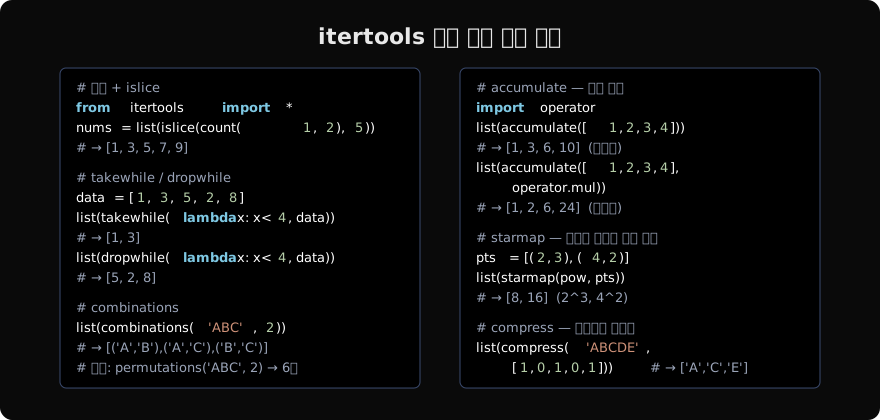
list(takewhile(lambda x: x < 4, data))   # [1, 3]

# 조건이 True인 동안 건너뛰기
list(dropwhile(lambda x: x < 4, data))  # [5, 2, 8, 4]
중요한 점: 조건이 처음 False가 되는 순간 동작이 결정됩니다. 뒤에 조건을 다시 만족하는 요소가 있어도 영향을 주지 않습니다.
filterfalse / compress
from itertools import filterfalse, compress

# filterfalse — filter의 반대
list(filterfalse(lambda x: x % 2, range(10)))
# [0, 2, 4, 6, 8]

# compress — 마스크 배열로 필터링
list(compress('ABCDE', [1, 0, 1, 0, 1]))
# ['A', 'C', 'E']
groupby — 그룹화
from itertools import groupby

# 주의: groupby는 정렬된 데이터에서만 정확히 동작합니다
data = [
    {'dept': 'dev', 'name': '김개발'},
    {'dept': 'dev', 'name': '이코딩'},
    {'dept': 'qa', 'name': '박테스트'},
]
data.sort(key=lambda x: x['dept'])

for dept, members in groupby(data, key=lambda x: x['dept']):
    print(dept, list(members))
# dev [{'dept': 'dev', 'name': '김개발'}, ...]
# qa  [{'dept': 'qa', 'name': '박테스트'}]
정렬 없이 쓰면 같은 키가 흩어져 있을 때 별도 그룹으로 처리됩니다. 항상 sort(key=...)를 먼저 하세요.
조합형 이터레이터
product — 데카르트 곱
from itertools import product

# 중첩 for 루프 대체
for x, y in product([1, 2], ['a', 'b']):
    print(x, y)
# 1 a / 1 b / 2 a / 2 b

# repeat로 같은 이터러블 반복
list(product('AB', repeat=2))
# [('A','A'), ('A','B'), ('B','A'), ('B','B')]
permutations / combinations
from itertools import permutations, combinations, combinations_with_replacement

items = 'ABC'

# 순열 (순서 고려, 중복 없음)
list(permutations(items, 2))
# [('A','B'), ('A','C'), ('B','A'), ('B','C'), ('C','A'), ('C','B')]

# 조합 (순서 무관, 중복 없음)
list(combinations(items, 2))
# [('A','B'), ('A','C'), ('B','C')]

# 중복 조합
list(combinations_with_replacement('AB', 2))
# [('A','A'), ('A','B'), ('B','B')]
accumulate와 starmap
from itertools import accumulate, starmap
import operator

# accumulate — 누적 집계
list(accumulate([1, 2, 3, 4]))                        # 누적합 [1, 3, 6, 10]
list(accumulate([1, 2, 3, 4], operator.mul))           # 누적곱 [1, 2, 6, 24]
list(accumulate([3, 1, 4, 1, 5], max))                 # 누적 최대값 [3, 3, 4, 4, 5]

# starmap — 인자 목록을 언팩해 함수 적용
pts = [(2, 5), (3, 2), (10, 3)]
list(starmap(pow, pts)) # [32, 9, 1000]accumulate()는 3.8부터 initial 파라미터가 추가되어 초깃값도 지정 가능합니다.
실전 패턴: 슬라이딩 윈도우
표준 라이브러리에는 sliding_window()가 없지만, itertools로 쉽게 만들 수 있습니다.
from itertools import islice

def sliding_window(iterable, n):
    it = iter(iterable)
    window = list(islice(it, n))
    if len(window) == n:
        yield tuple(window)
    for item in it:
        window.append(item)
        window.pop(0)
        yield tuple(window)

list(sliding_window([1, 2, 3, 4, 5], 3))
# [(1,2,3), (2,3,4), (3,4,5)]
Python 3.12부터는 itertools.batched()가 추가되어 고정 크기 배치로 분할할 수 있습니다.
# Python 3.12+
from itertools import batched
list(batched('ABCDEFG', 3))
# [('A','B','C'), ('D','E','F'), ('G',)]
성능 특성
itertools 함수는 C로 구현된 내장 함수이므로 Python 루프보다 빠릅니다. 특히 대용량 이터레이터를 다룰 때 차이가 큽니다.
import timeit

# 리스트 컴프리헨션 vs chain.from_iterable
nested = [[i] * 10 for i in range(1000)]

t1 = timeit.timeit(lambda: [x for sub in nested for x in sub], number=1000)
t2 = timeit.timeit(lambda: list(chain.from_iterable(nested)), number=1000)
# chain.from_iterable이 보통 20~40% 빠름
지난 글: time 모듈 vs datetime: 언제 무엇을 쓸까
다음 글: functools.lru_cache: 메모이제이션 캐싱
읽어주셔서 감사합니다. 😊
PALDYN / ARTICLE AI
글의 개념, 수식, 코드에 대해 물어보세요.
질문과 관련된 문단을 골라 답변의 문맥으로 사용합니다.생각 중 · 0초