

itertools 핵심: chain, product, combinations
Python itertools 모듈의 핵심 함수들 chain, product, permutations, combinations, groupby, takewhile을 실용 예제와 함께 설명합니다.
지난 글에서 비동기 제너레이터를 살펴봤다. 이번 글에서는 Python 표준 라이브러리의 itertools 모듈을 탐구한다. 이터레이터를 다루는 강력한 함수들이 모여 있어, 중첩 for 루프를 간결하게 대체하고 데이터 파이프라인을 효율적으로 구성할 수 있다.
itertools란
itertools 모듈은 이터레이터를 생성하고 조합하는 함수들의 집합이다. 모든 함수가 이터레이터를 반환하므로 지연 평가가 기본이다. APL, Haskell, SML 등 함수형 언어의 영향을 받아 설계됐다.
import itertools
# 또는 특정 함수만
from itertools import chain, product, combinations, permutations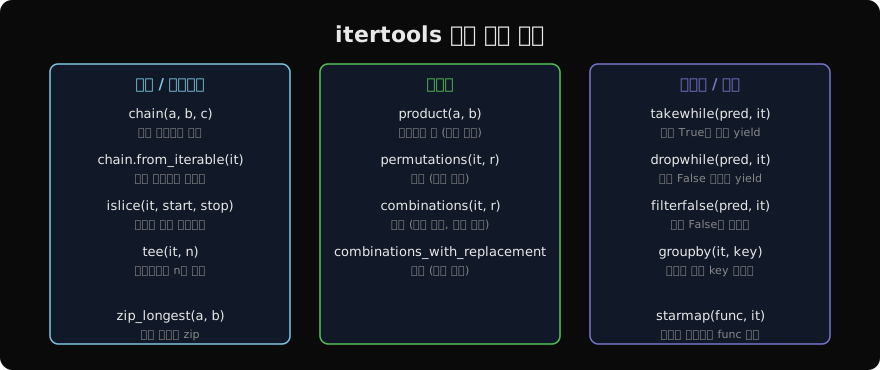
chain() — 이터러블 연결
여러 이터러블을 순서대로 연결한다. 리스트 + 연산자와 달리 메모리를 미리 할당하지 않는다.
from itertools import chain

a = [1, 2, 3]
b = (4, 5)
c = range(6, 8)

result = list(chain(a, b, c)) # [1, 2, 3, 4, 5, 6, 7]chain.from_iterable()은 중첩 이터러블을 한 단계 펼친다.
nested = [[1, 2], [3, 4], [5]]
flat = list(chain.from_iterable(nested))   # [1, 2, 3, 4, 5]

# 문자열 리스트에서 문자 하나씩 꺼내기
words = ["ab", "cd", "e"]
chars = list(chain.from_iterable(words))   # ['a', 'b', 'c', 'd', 'e']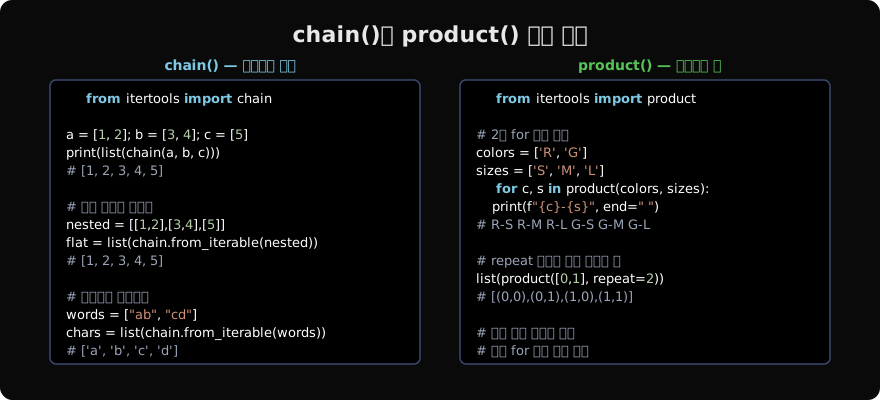
product() — 데카르트 곱
여러 이터러블의 데카르트 곱을 생성한다. 중첩 for 루프를 간결하게 대체한다.
from itertools import product

# 2중 for 루프 대체
for i, j in product(range(3), range(2)):
    print(i, j)
# 0 0 / 0 1 / 1 0 / 1 1 / 2 0 / 2 1

# repeat 인자로 자기 자신과의 곱
bits = list(product([0, 1], repeat=3))
# [(0,0,0),(0,0,1),(0,1,0),(0,1,1),(1,0,0),(1,0,1),(1,1,0),(1,1,1)]
실용 예: 파라미터 그리드 탐색 (하이퍼파라미터 튜닝)
learning_rates = [0.001, 0.01, 0.1]
batch_sizes = [16, 32, 64]

for lr, bs in product(learning_rates, batch_sizes):
    train_model(lr=lr, batch_size=bs)
permutations() — 순열
r개를 선택해 순서 있는 배열을 생성한다.
from itertools import permutations

letters = ['A', 'B', 'C']

# 2개 선택 순열
for p in permutations(letters, 2):
    print(p)
# ('A','B') ('A','C') ('B','A') ('B','C') ('C','A') ('C','B')

# 전체 순열 (r 생략 시)
print(len(list(permutations(range(5)))))  # 5! = 120
combinations() — 조합
r개를 선택하되 순서를 고려하지 않는다. 요소 중복 없음.
from itertools import combinations

# 로또 번호처럼 5개 중 3개 선택
for c in combinations([1, 2, 3, 4, 5], 3):
    print(c)
# (1,2,3) (1,2,4) (1,2,5) (1,3,4) (1,3,5) (1,4,5)
# (2,3,4) (2,3,5) (2,4,5) (3,4,5)

# 개수: C(5,3) = 10
중복 조합은 combinations_with_replacement()를 쓴다.
from itertools import combinations_with_replacement

list(combinations_with_replacement([1, 2], 2))
# [(1,1), (1,2), (2,2)]
groupby() — 연속 그룹화
연속된 동일 키를 가진 요소를 그룹화한다. 정렬된 데이터에서 특히 유용하다.
from itertools import groupby

data = [("A", 1), ("A", 2), ("B", 3), ("B", 4), ("A", 5)]

for key, group in groupby(data, key=lambda x: x[0]):
    items = list(group)
    print(key, items)
# A [('A', 1), ('A', 2)]
# B [('B', 3), ('B', 4)]
# A [('A', 5)] ← A가 다시 나타남 (중간에 B가 있었으므로)groupby는 SQL GROUP BY와 다르다. 연속된 값만 같은 그룹으로 묶는다. 비연속 그룹을 원하면 먼저 정렬해야 한다.
# 알파벳으로 정렬 후 그룹화
words = ["banana", "apple", "avocado", "blueberry", "cherry"]
words.sort()   # 반드시 정렬 먼저

for letter, group in groupby(words, key=lambda w: w[0]):
    print(letter, list(group))
# a ['apple', 'avocado']
# b ['banana', 'blueberry']
# c ['cherry']
takewhile()과 dropwhile()
from itertools import takewhile, dropwhile

nums = [1, 3, 5, 4, 6, 2, 8]

# 조건이 True인 동안만 yield
small = list(takewhile(lambda x: x < 5, nums))   # [1, 3]

# 조건이 처음으로 False가 된 후부터 yield
rest = list(dropwhile(lambda x: x < 5, nums))    # [5, 4, 6, 2, 8]
                                                   # ← 5부터 시작 (5>=5이므로)
islice() — 이터레이터 슬라이싱
인덱스 접근이 없는 이터레이터를 슬라이싱할 수 있다.
from itertools import islice

def infinite_counter():
    n = 0
    while True:
        yield n
        n += 1

first_ten = list(islice(infinite_counter(), 10))   # [0, 1, ..., 9]

# 5번째부터 10번째까지
partial = list(islice(infinite_counter(), 5, 10))  # [5, 6, 7, 8, 9]
무한 이터레이터를 제한할 때 특히 유용하다 (다음 글 참조).
starmap() — 언패킹 map
map(func, iterable)과 유사하지만, 이터러블의 각 요소가 튜플이면 자동으로 언패킹해 함수에 전달한다.
from itertools import starmap

points = [(1, 2), (3, 4), (5, 6)]

# starmap: 각 튜플을 언패킹해서 pow에 전달
results = list(starmap(pow, points))   # [1**2, 3**4, 5**6] = [1, 81, 15625]

# map으로 같은 결과
results = list(map(lambda p: pow(*p), points))
파이프라인 예제
itertools를 조합하면 복잡한 데이터 변환을 선언적으로 표현할 수 있다.
from itertools import chain, islice, groupby

logs = [
    ("ERROR", "db connect failed"),
    ("INFO",  "request received"),
    ("ERROR", "timeout"),
    ("DEBUG", "cache hit"),
]

# 처음 10개 로그에서 ERROR만 추출
errors = islice(
    (msg for level, msg in logs if level == "ERROR"),
    10
)

for msg in errors:
    print(msg)
# db connect failed
# timeout
정리
| 함수 | 주요 용도 |
|---|---|
chain(*its) | 여러 이터러블 순차 연결 |
chain.from_iterable(it) | 중첩 이터러블 한 단계 펼치기 |
product(*its, repeat=1) | 데카르트 곱 (중첩 for 대체) |
permutations(it, r) | 순열 |
combinations(it, r) | 조합 (중복 불가) |
groupby(it, key) | 연속 그룹화 |
takewhile(pred, it) | 조건 True 동안 yield |
islice(it, stop) | 이터레이터 슬라이싱 |
다음 글에서는 itertools의 무한 이터레이터인 count, cycle, repeat와 이를 제어하는 islice를 더 깊이 탐구한다.
지난 글: 비동기 제너레이터: async def + yield의 결합
다음 글: 무한 이터레이터: count, cycle, repeat와 islice 활용
읽어주셔서 감사합니다. 😊
PALDYN / ARTICLE AI
글의 개념, 수식, 코드에 대해 물어보세요.
질문과 관련된 문단을 골라 답변의 문맥으로 사용합니다.생각 중 · 0초